An autonomous agent that learns to design optical lens systems the way expert opticians do — starting from experience, refining under real physical feedback, and getting better with every design it attempts.
Every camera, telescope, and AR headset relies on a lens system — a precise arrangement of curved glass elements that bends light into a sharp image. Designing one is a notoriously difficult, non-convex optimization problem: a handful of parameters such as curvature, spacing, and glass material interact in ways that are almost impossible to reason about from first principles alone.
In practice, expert opticians rarely solve this by brute-force search. They draw on years of accumulated intuition — starting from a known-good configuration and iteratively refining it while watching how the optics respond. This project asks a simple question: can a language-model agent learn to work the same way — retrieving a sensible starting point, iterating under physical feedback, and, crucially, getting measurably better at the task over time rather than solving every design from scratch?
A classical imaging system arranges an object plane, a sequence of refractive elements, an aperture stop, and an image plane so that light from the scene converges into a sharp picture. A handful of specifications have to be satisfied all at once — the field of view the lens can see, the aperture size (F-number) that controls light-gathering and depth of field, the focal length that sets magnification, and the overall physical length of the assembly. Balancing all of them simultaneously, while keeping aberrations low, is what makes the design space so unforgiving.
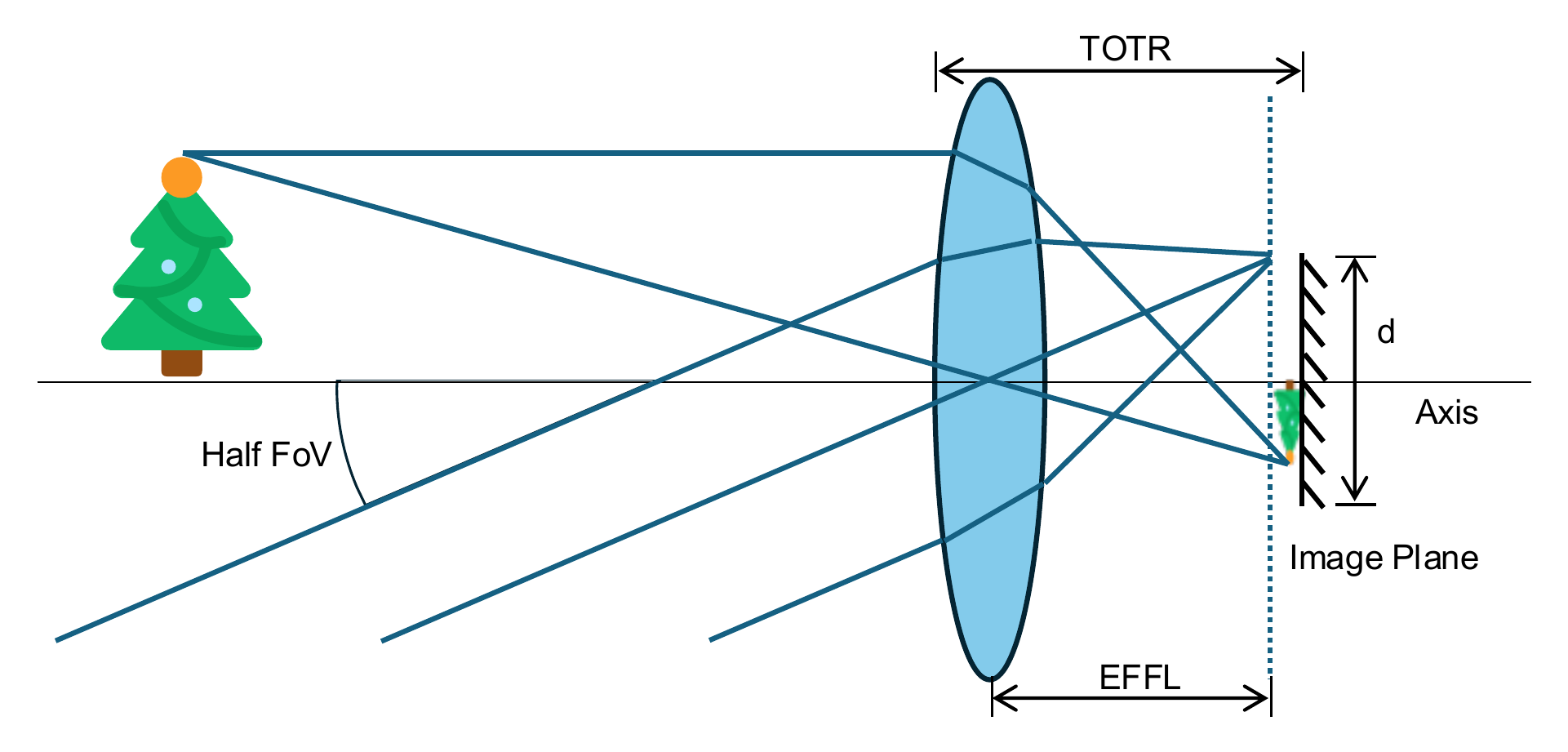
Rather than treating design as an open-ended search, the agent's workflow is structured around three principles that mirror how a human optician actually works.
The agent first retrieves a physically compatible starting design from a large library of previously explored lens structures, matched by optical compatibility rather than superficial similarity.
It proposes structural edits — inserting elements, adjusting curvatures, swapping glass materials — and receives immediate feedback from an optical ray-tracing simulator, keeping every step grounded in physics rather than guesswork.
A self-evolving loop lets the agent reflect on both successes and failures, distill reusable design heuristics, and carry that experience into future, harder tasks — much like an optician builds intuition over a career.
This page gives a high-level preview of an ongoing research project. Implementation details, benchmark results, and code are intentionally withheld for now, and will be shared here as the project matures.